
Latest Bookshelf Design Trends for Modern Indian Homes (2026 Guide)
You walk into a furniture store, spot a wooden bookshelf design that looks stunning under the showroom lights, bring it home, and within a month it feels wrong. It does not fit the wall, the books hang over the edges, and the bookcase shelves start to sag under the weight of your collection. This usually comes down to one thing: picking a bookshelf design without understanding what actually works for Indian homes.
The truth is, there is no single best bookshelf design that suits everyone. What works is knowing the trends shaping bookshelf design today, understanding which type and material suit your space, humidity levels, and load needs, and then making a choice that lasts. This guide walks you through exactly that, from the latest bookshelf design trends to material comparisons, pricing, and styling tips built for Indian homes.
Latest Bookshelf Design Trends for Modern Indian Homes (2026 Guide)
You walk into a furniture store, spot a wooden bookshelf design that looks stunning under the showroom lights, bring it home, and within a month it feels wrong. It does not fit the wall, the books hang over the edges, and the bookcase shelves start to sag under the weight of your collection. This usually comes down to one thing: picking a bookshelf design without understanding what actually works for Indian homes.
The truth is, there is no single best bookshelf design that suits everyone. What works is knowing the trends shaping bookshelf design today, understanding which type and material suit your space, humidity levels, and load needs, and then making a choice that lasts. This guide walks you through exactly that, from the latest bookshelf design trends to material comparisons, pricing, and styling tips built for Indian homes.
Why Most Bookshelves Don't Last in Indian Homes
Walk into ten Indian homes and you will likely find at least six bookshelves with sagging middle shelves or swollen edges. This is rarely a bookshelf design flaw, it is a material problem. Cheap engineered wood and particle board units are everywhere because they are affordable, but they were never built for Indian conditions.
Particle board absorbs moisture quickly during monsoon months, causing shelves to swell, warp, and crack at the joints. Add a stack of hardbound books and the middle shelf starts bowing within a year or two. A solid wood bookshelf design behaves completely differently, since solid timber resists humidity far better, holds its shape under load, and ages with character instead of falling apart.
Once you start thinking of buy bookshelf for home as a long-term investment rather than a quick fix, the way you judge a bookshelf design changes. You stop asking does it look nice in the photo and start asking will this shelf still be standing straight in five years, whether you are shopping for a bookshelf for home use or furnishing an entire study.
Why Most Bookshelves Don't Last in Indian Homes
Walk into ten Indian homes and you will likely find at least six bookshelves with sagging middle shelves or swollen edges. This is rarely a bookshelf design flaw, it is a material problem. Cheap engineered wood and particle board units are everywhere because they are affordable, but they were never built for Indian conditions.
Particle board absorbs moisture quickly during monsoon months, causing shelves to swell, warp, and crack at the joints. Add a stack of hardbound books and the middle shelf starts bowing within a year or two. A solid wood bookshelf design behaves completely differently, since solid timber resists humidity far better, holds its shape under load, and ages with character instead of falling apart.
Once you start thinking of buy bookshelf for home as a long-term investment rather than a quick fix, the way you judge a bookshelf design changes. You stop asking does it look nice in the photo and start asking will this shelf still be standing straight in five years, whether you are shopping for a bookshelf for home use or furnishing an entire study.
Top Bookshelf Design Trends in India Right Now
Bookshelf design trends in Indian homes have moved well past the plain rectangular unit pushed against a wall. Here is what is actually popular in modern bookshelf design right now.
01
Open & ladder shelving
Open and ladder shelvin has become a favourite for smaller apartments. These units lean against the wall or stand freely, using vertical space without feeling bulky, and they suit an open bookshelf look that keeps a room feeling airy.
02
Room-divider bookshelves
Room-divider bookshelves are gaining traction in open-plan homes, especially where a living and dining area share one space. A double-sided wooden bookcase design splits the zone visually while adding storage on both sides.
03
Sculptural & asymmetric shelving
Sculptural and asymmetric shelving is one of the more striking modern bookshelf designs right now. Instead of even, boxy compartments, this style uses uneven shelf heights and angled supports to create a piece that works as art and storage together.
04
Minimalist floating units
Minimalist floating units suit compact bedrooms and study corners where floor space is limited. A wall hanging bookshelf keeps the floor clear and works well as a bookshelf design wall feature in smaller rooms or apartments.
05
Mixed display & storage designs
Mixed display and storage designs combine open shelving with a closed cabinet section, letting you show off favourite books and decor while hiding clutter below.
These trends point to two broad categories worth understanding before you buy: wall-mounted bookshelf and freestanding bookshelf. The next section breaks down which one actually fits your space.
Top Bookshelf Design Trends in India Right Now
Bookshelf design trends in Indian homes have moved well past the plain rectangular unit pushed against a wall. Here is what is actually popular in modern bookshelf design right now.
01
Open & ladder shelving
Open and ladder shelvin has become a favourite for smaller apartments. These units lean against the wall or stand freely, using vertical space without feeling bulky, and they suit an open bookshelf look that keeps a room feeling airy.
02
Room-divider bookshelves
Room-divider bookshelves are gaining traction in open-plan homes, especially where a living and dining area share one space. A double-sided wooden bookcase design splits the zone visually while adding storage on both sides.
03
Sculptural & asymmetric shelving
Sculptural and asymmetric shelving is one of the more striking modern bookshelf designs right now. Instead of even, boxy compartments, this style uses uneven shelf heights and angled supports to create a piece that works as art and storage together.
04
Minimalist floating units
Minimalist floating units suit compact bedrooms and study corners where floor space is limited. A wall hanging bookshelf keeps the floor clear and works well as a bookshelf design wall feature in smaller rooms or apartments.
05
Mixed display & storage designs
Mixed display and storage designs combine open shelving with a closed cabinet section, letting you show off favourite books and decor while hiding clutter below.
These trends point to two broad categories worth understanding before you buy: wall-mounted bookshelf and freestanding bookshelf. The next section breaks down which one actually fits your space.
Wall-Mounted vs Freestanding Bookshelf: Which Suits Your Space?
This is the decision most people get stuck on, and it comes down to your wall condition, ceiling height, and how much floor space you can spare.

Wall-Mounted Bookshelf Design
A wall-mounted bookshelf works best when floor space is limited or when you want a piece that visually floats rather than sits heavy in the room. Before installing one, check your wall type. Load-bearing walls handle weight far better than partition walls, and ceiling height matters too, since a tall bookshelf design on wall can look cramped in a room with low ceilings.
Product Spotlight
Flux Bookcase
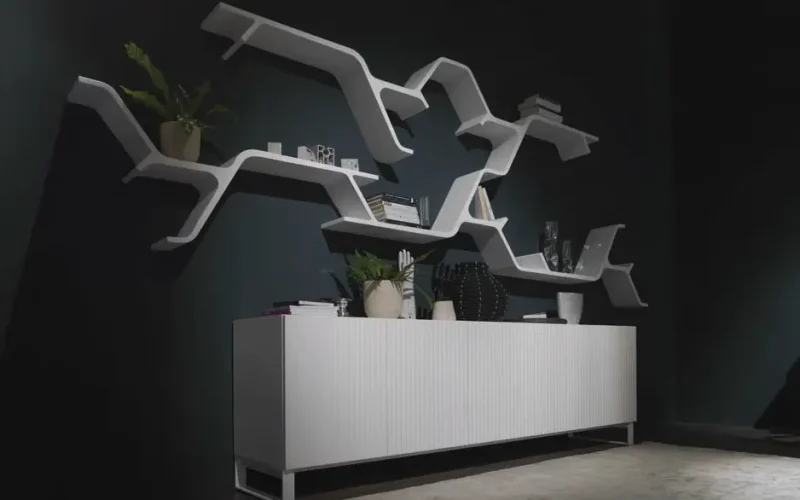
The Flux Bookcase is a wall-mounted wooden bookshelf design built around a fluid, asymmetric geometry that reads more like a sculptural piece than a standard shelf unit. It weighs 25 kg and is priced at ₹56,840, discounted 30 percent from ₹81,200. It suits compact, modern spaces where you want strong visual impact without eating into floor area, and fits neatly into an aesthetic bookshelf setup for a study or living room accent wall.

Freestanding Bookshelf Design
A freestanding bookshelf works on open-shelf display logic and gives you more flexibility to move it later. These suit larger living rooms and studies where the shelf itself can act as a centrepiece rather than a background element.
Product Spotlight
Cael Bookcase
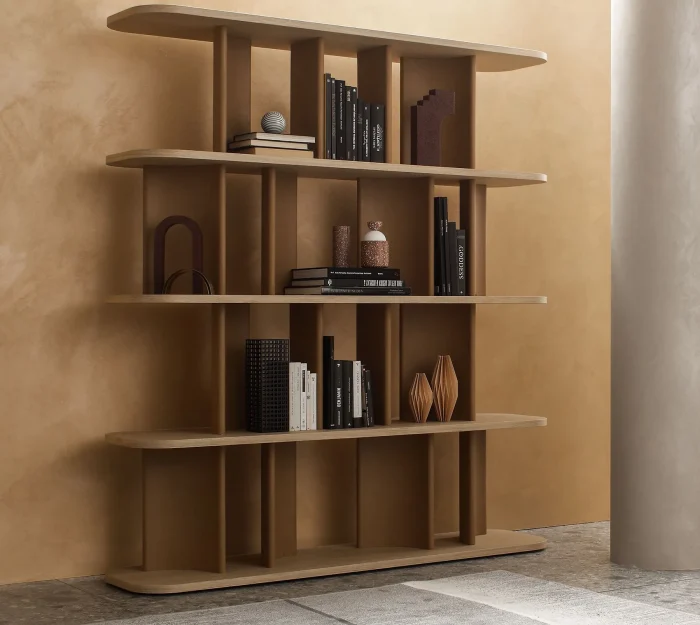
The Cael Bookcase is a freestanding bookshelf design built as a statement piece, with rhythmic vertical supports that give it a strong architectural rhythm. It weighs 90 kg and is priced at ₹81,200, a solid choice for anyone building a long-term living room bookshelf that can carry a genuinely heavy book collection.
Whichever you pick, both options above reflect the direction bookshelf design is heading in Indian homes right now: functional, sculptural, and built to last rather than purely decorative.
Wall-Mounted vs Freestanding Bookshelf: Which Suits Your Space?
This is the decision most people get stuck on, and it comes down to your wall condition, ceiling height, and how much floor space you can spare.
Wall-Mounted Bookshelf Design
A wall-mounted bookshelf works best when floor space is limited or when you want a piece that visually floats rather than sits heavy in the room. Before installing one, check your wall type. Load-bearing walls handle weight far better than partition walls, and ceiling height matters too, since a tall bookshelf design on wall can look cramped in a room with low ceilings.
Product Spotlight
Flux Bookcase
The Flux Bookcase is a wall-mounted wooden bookshelf design built around a fluid, asymmetric geometry that reads more like a sculptural piece than a standard shelf unit. It weighs 25 kg and is priced at ₹56,840, discounted 30 percent from ₹81,200. It suits compact, modern spaces where you want strong visual impact without eating into floor area, and fits neatly into an aesthetic bookshelf setup for a study or living room accent wall.
Freestanding Bookshelf Design
A freestanding bookshelf works on open-shelf display logic and gives you more flexibility to move it later. These suit larger living rooms and studies where the shelf itself can act as a centrepiece rather than a background element.
Product Spotlight
Cael Bookcase
The Cael Bookcase is a freestanding bookshelf design built as a statement piece, with rhythmic vertical supports that give it a strong architectural rhythm. It weighs 90 kg and is priced at ₹81,200, a solid choice for anyone building a long-term living room bookshelf that can carry a genuinely heavy book collection.
Whichever you pick, both options above reflect the direction bookshelf design is heading in Indian homes right now: functional, sculptural, and built to last rather than purely decorative.
Solid Wood vs Engineered Wood: Which Lasts Longer?
This is the material question that decides whether your wooden bookshelf lasts five years or fifteen.
, including MDF and particle board, is manufactured from wood fibres bonded with resin. It is lighter and cheaper upfront, but it does not handle Indian humidity well. Moisture seeps into exposed edges, causing shelves to swell and lose strength over time, and under sustained weight from books, these shelves tend to sag noticeably within a couple of years.
behaves very differently. A solid wood bookshelf i s cut from natural timber, with a tighter grain structure and far better resistance to moisture and load. It carries heavier book collections without bowing, and minor scratches only add character instead of ruining the piece. Over a ten-year span, a well-made wooden bookshelf design typically costs less per year of use than replacing an engineered wood unit two or three times.
If you live in a coastal or high-humidity city, this comparison matters even more, since engineered wood struggles noticeably in those climates. For anyone shopping for a bookshelf for home use that needs to survive monsoons and years of daily use, a solid wood bookshelf design is the safer long-term choice.
Solid Wood vs Engineered Wood: Which Lasts Longer?
This is the material question that decides whether your wooden bookshelf lasts five years or fifteen.
, including MDF and particle board, is manufactured from wood fibres bonded with resin. It is lighter and cheaper upfront, but it does not handle Indian humidity well. Moisture seeps into exposed edges, causing shelves to swell and lose strength over time, and under sustained weight from books, these shelves tend to sag noticeably within a couple of years.
behaves very differently. A solid wood bookshelf i s cut from natural timber, with a tighter grain structure and far better resistance to moisture and load. It carries heavier book collections without bowing, and minor scratches only add character instead of ruining the piece. Over a ten-year span, a well-made wooden bookshelf design typically costs less per year of use than replacing an engineered wood unit two or three times.
If you live in a coastal or high-humidity city, this comparison matters even more, since engineered wood struggles noticeably in those climates. For anyone shopping for a bookshelf for home use that needs to survive monsoons and years of daily use, a solid wood bookshelf design is the safer long-term choice.
Bookshelf Price Guide in India
Bookshelf prices in India span a wide range, and the gap usually comes down to material, size, and craftsmanship.
Basic engineered wood units start around ₹5,000 to ₹8,000. These work for light use, temporary setups, or budget-conscious first homes, but expect a shorter lifespan and visible wear within a couple of years.
Mid-range units, often a mix of engineered wood with some solid wood elements, fall between ₹15,000 and ₹40,000 depending on size and finish.
Premium solid wood bookshelf design pieces sit in the ₹56,840 to ₹81,200 bracket, similar to the Flux and Cael pieces covered above. At this tier, you pay for solid timber construction, joinery that will not loosen with age, and a bookshelf design that holds up as both a functional bookcase and a piece of furniture worth keeping. If you plan to buy a bookshelf online at this price point, check the wood type, weight capacity, and warranty terms first, since these details matter more than the finish photos.
Bookshelf Price Guide in India
Bookshelf prices in India span a wide range, and the gap usually comes down to material, size, and craftsmanship.
Basic engineered wood units start around ₹5,000 to ₹8,000. These work for light use, temporary setups, or budget-conscious first homes, but expect a shorter lifespan and visible wear within a couple of years.
Mid-range units, often a mix of engineered wood with some solid wood elements, fall between ₹15,000 and ₹40,000 depending on size and finish.
Premium solid wood bookshelf design pieces sit in the ₹56,840 to ₹81,200 bracket, similar to the Flux and Cael pieces covered above. At this tier, you pay for solid timber construction, joinery that will not loosen with age, and a bookshelf design that holds up as both a functional bookcase and a piece of furniture worth keeping. If you plan to buy a bookshelf online at this price point, check the wood type, weight capacity, and warranty terms first, since these details matter more than the finish photos.
How to Style Bookshelf
Good wooden bookshelf styling is part practical, part visual. A few rules make a real difference
01
Match shelf height to your books
Standard hardbacks need roughly 28 to 30 cm of clearance, while paperbacks sit comfortably on shelves as low as 20 cm. If your unit has adjustable shelves, use that flexibility instead of forcing every book onto one fixed height.
02
Distribute weight evenly
Heavier books belong on lower shelves, for stability and to prevent the frame from tipping over time. This matters even more for a tall wall hanging bookshelf, where uneven weight can strain the wall mounts.
03
Mix books with decor
Group books both vertically and horizontally, and break up the rows with a plant, a small tray, or a framed photo every second or third shelf. This kind of bookshelf design detail keeps an open bookshelf from looking like a library card catalogue.
04
Adjust for the room
A bedroom bookshelf can lean personal and soft, with framed photos and travel finds. A living room bookshelf design usually needs to feel a bit more curated, since it is the piece guests actually notice. A home office or study shelf works best kept mostly functional, with decor kept minimal so it does not compete with your workspace.
How to Style Bookshelf
Good wooden bookshelf styling is part practical, part visual. A few rules make a real difference
01
Match shelf height to your books
Standard hardbacks need roughly 28 to 30 cm of clearance, while paperbacks sit comfortably on shelves as low as 20 cm. If your unit has adjustable shelves, use that flexibility instead of forcing every book onto one fixed height.
02
Distribute weight evenly
Heavier books belong on lower shelves, for stability and to prevent the frame from tipping over time. This matters even more for a tall wall hanging bookshelf, where uneven weight can strain the wall mounts.
03
Mix books with decor
Group books both vertically and horizontally, and break up the rows with a plant, a small tray, or a framed photo every second or third shelf. This kind of bookshelf design detail keeps an open bookshelf from looking like a library card catalogue.
04
Adjust for the room
A bedroom bookshelf can lean personal and soft, with framed photos and travel finds. A living room bookshelf design usually needs to feel a bit more curated, since it is the piece guests actually notice. A home office or study shelf works best kept mostly functional, with decor kept minimal so it does not compete with your workspace.
Final Thoughts
Choosing the right bookshelf design is not about chasing whatever looks good in a catalogue. It is about understanding how the piece will hold up in your climate, fit your space, and carry your collection for years, not months. Whether you lean toward a wall-mounted bookshelf design like the Flux Bookcase or a freestanding one like the Cael Bookcase, solid wood construction and a design suited to your room will always outlast a quick, cheap fix.
If you are ready to explore options, browse the Bookcases collection at Twigs Direct, including the Flux and Cael bookcases featured above, and find a bookshelf design built to last.
Browse the Bookcases collection at Twigs Direct, including the Flux and Cael bookcases featured above.
Final Thoughts
Choosing the right bookshelf design is not about chasing whatever looks good in a catalogue. It is about understanding how the piece will hold up in your climate, fit your space, and carry your collection for years, not months. Whether you lean toward a wall-mounted bookshelf design like the Flux Bookcase or a freestanding one like the Cael Bookcase, solid wood construction and a design suited to your room will always outlast a quick, cheap fix.
If you are ready to explore options, browse the Bookcases collection at Twigs Direct, including the Flux and Cael bookcases featured above, and find a bookshelf design built to last.
Browse the Bookcases collection at Twigs Direct, including the Flux and Cael bookcases featured above.
FAQ's
Open and ladder shelving, room-divider bookcases, sculptural asymmetric units, minimalist floating shelves, and mixed display-and-storage designs are currently the most popular directions in bookshelf design for Indian homes.
Standard hardbacks generally need about 28 to 30 cm of clearance, while paperbacks and smaller books fit well on shelves as low as 20 cm. Adjustable shelving lets you customise this bookshelf design as your collection grows.
A wall-mounted bookshelf design is usually the better fit for small rooms since it keeps the floor clear and adds a lighter visual footprint. A freestanding bookshelf design suits larger rooms where it can double as a centrepiece.
Solid wood resists humidity far better than engineered wood or particle board in most bookshelf design applications. While no material is completely immune to extreme moisture, a well-made solid wood bookshelf design holds its shape much longer than budget alternatives.
Premium solid wood bookshelf design pieces typically range from around ₹55,000 to ₹85,000 depending on size, design complexity, and finish. This tier usually offers the best balance of durability, craftsmanship, and long-term value.